
Statutory consolidation at a turning point: BFC and HFM reach the end of an era as AI enters the picture
Prepare to migrate from SAP BFC or Oracle HFM and see how AI can save time in statutory consolidation while maintaining control.

How can you prepare to migrate from SAP BFC or Oracle HFM while incorporating AI into statutory consolidation? We look at the decisions to make about rules, data and controls, as well as the tasks where AI can save consolidation teams time.
Statutory consolidation is undergoing two shifts at once. The tools it has relied on for twenty years are reaching the end of their useful life, and AI is becoming part of the job. Groups that address both shifts together stand to gain much more than a change of software.
For a long time, consolidation was the most stable area of finance. Standards evolved and consolidation scopes shifted, but the software stayed the same. SAP BFC and Oracle HFM supported generations of consolidation professionals, with rules painstakingly built over time, reporting packages and controls.
That foundation is now being called into question for two reasons that have emerged at the same time. The first is technical. The vendors have moved on from their legacy solutions. The second runs deeper. Generative AI and AI agents are beginning to change how consolidated financial statements are produced.
Each development is manageable on its own. Together, they raise a fundamental question. What should the consolidation function be built on for the next ten years?
The end of an era for BFC and HFM as their vendors move on
BFC and HFM still work and will continue to do so for several more years. Their vendors have shifted their investment. SAP is planning no further functional enhancements to BFC, and Oracle is reserving most of its innovations, including AI, for its cloud offering. The questions now are when to migrate and which solution to move to.
Two distinctions matter. For BFC, the extension to 2030 buys time. SAP provides tools to transfer data to Group Reporting, and the posting logic falls outside their scope. The full set of consolidation rules, with all its complexity, has to be rebuilt. SAP also offers another route beyond Group Reporting. In October 2026, it announced SAP Enterprise Financial Consolidation, a multi-source offering expected to enter an Early Adopter programme in the first quarter of 2027. Whichever solution you choose, the rules still need to be rebuilt.
For HFM, the support end date moves back each year, which can create a false sense of security. In practice, an instance that falls behind on updates stops receiving patches, even if support is still being paid for. Innovation, including AI, now takes place in the cloud.
Staying put comes at a cost. Specialist skills are increasingly scarce, infrastructure is ageing, security risks remain, and above all, the gap with what modern solutions offer is widening.
Migration is more than a change of software
The most common pitfall is treating migration as a technical project focused on carrying over the chart of accounts, copying the rules and recreating the reports. The result is a new tool that works like the old one, complete with the same inefficiencies.
A successful migration therefore starts with three simple questions.
1. What takes up our time today?
Intercompany reconciliations, manual adjustments, back-and-forth with subsidiaries and Excel files maintained outside the system. These are where the gains can be found.
2. What role should consolidation play in the future?
Producing reliable financial statements remains the primary responsibility. The group also expects faster reporting, a link to budgeting and forecasting, and non-financial data (CSRD).
3. What data do we need, and at what level of quality?
A clean data model and well-governed master data are prerequisites for everything else, including AI.
This is the shift from consolidation to coordination. Finance’s role expands from collecting, reconciling and reporting data to designing the system that produces the information and making it useful for decision-making. The end of BFC and HFM is an opportunity to do that work.
Watch the webinar replay on replacing legacy consolidation tools
AI enters consolidation
All major vendors now incorporate AI into their financial close and consolidation solutions.
Consolidation teams are already seeing practical benefits.
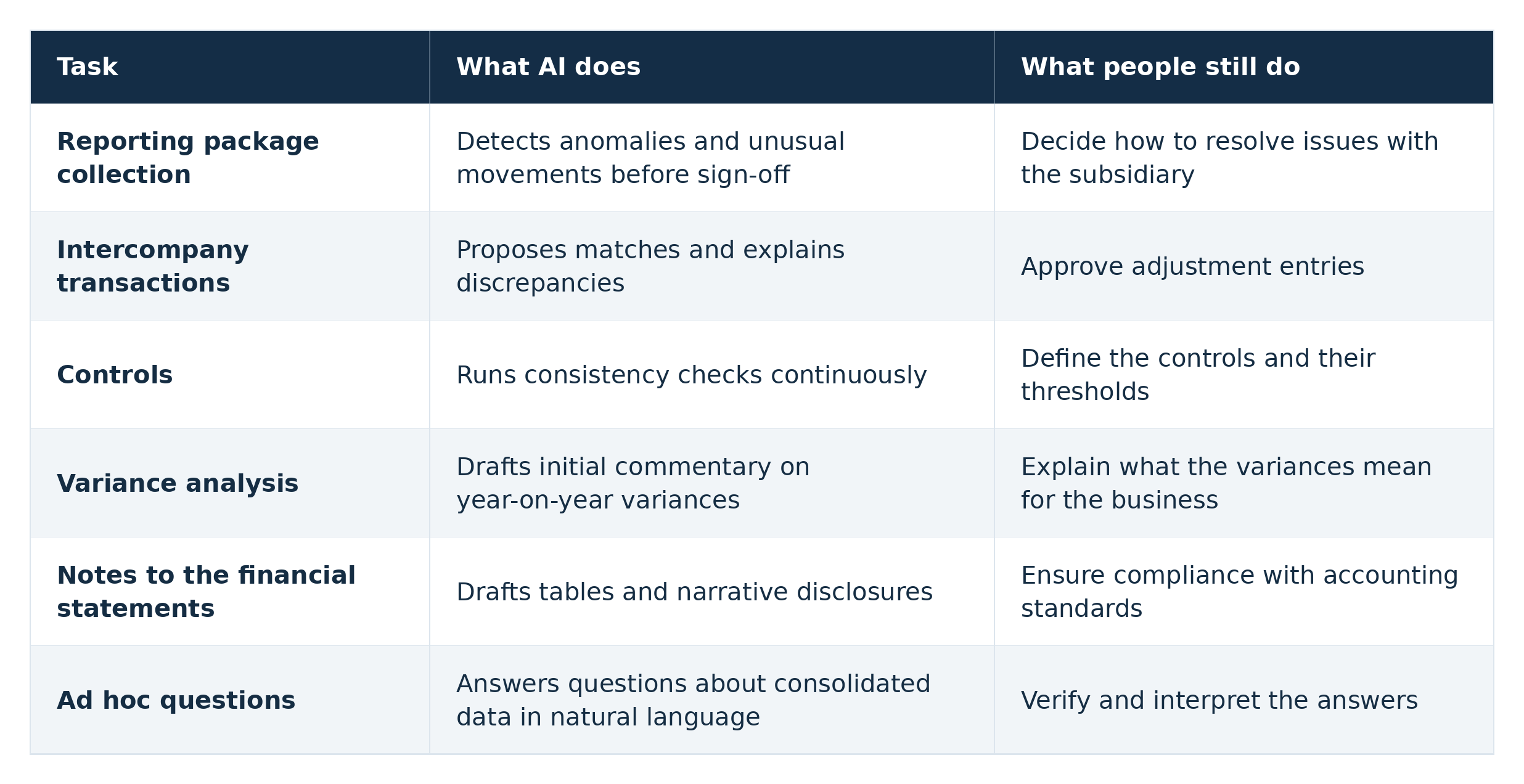
One fundamental limitation remains. An AI agent is only as good as the data and rules it can access. An agent embedded in an ERP system can only see that ERP system, and even a multi-source consolidation platform cannot fix poorly maintained master data. A group brings together multiple systems, multiple charts of accounts, acquisitions and disposals. Consolidation remains the layer where it all comes together, and this is where the quality of the rules and data makes the difference.
AI also speeds up the migration itself
AI can play a role in both the target system and the migration project. It is starting to speed up the extraction of rules and models from legacy tools, the mapping of charts of accounts, the initial configuration, and the comparison of results between the old and new tools during the parallel run.
Early reports, mainly from planning projects, point to very short timelines. They generally concern like-for-like migrations. In statutory consolidation, automated migration produces a draft. Consolidation specialists who know the history still need to validate it rule by rule.
Will AI replace or augment the consolidation specialist?
Teams everywhere are asking whether AI will act as an assistant or a replacement. Our view is that the consolidation specialist remains in place, with more time to focus on the work that adds the most value.
Repetitive tasks are disappearing, from chasing subsidiaries and checking intercompany discrepancies line by line to formatting tables. Judgement remains and becomes more valuable. A formula alone cannot determine the accounting treatment for a step acquisition, a legal restructuring or the first application of a standard. It takes an understanding of the legal, tax and economic context, and sometimes a choice between several defensible treatments.
Statutory consolidation also makes the group accountable for what it publishes. A published figure must be substantiated, traceable and auditable. AI can make proposals. Sign-off remains a human responsibility.
The consolidation specialist’s role is therefore evolving towards three responsibilities.
- Design the rules, controls and data model that the tool and AI rely on.
- Oversee automated processing, flagged exceptions and proposals from AI agents.
- Explain the results to finance leadership and the decisions taken to the statutory auditors.
This calls for new skills. Consolidation specialists need to know how to frame a question for an AI assistant, critically assess its answer and understand the data model. The role calls for someone who can make complex issues understandable, beyond the scope of a purely technical or accounting profile.
Five recommendations for finance leaders
1. Start well ahead of the deadline.
A full statutory consolidation project often takes 12 to 18 months, including at least one year-end close run in parallel. With a 2030 deadline, planning starts now. IFRS 18, which applies to financial years beginning on or after 1 January 2027, already requires changes to how financial statements are presented. Coordinating the work avoids doing it twice.
2. Take stock of what you have.
Document the rules, adjustments, controls, reports and standalone files you actually use, and identify what is no longer needed.
3. Base your choice on use cases.
Test solutions on the issues you actually face, including complex intercompany transactions, changes to the consolidation scope, multiple accounting standards and integration with management reporting.
4. Scrutinise the AI capabilities.
Ask which features are in production, what can be traced and audited, and how group data is protected. Check how statutory auditors will be able to audit an AI proposal and what it will cost to use the AI features.
5. Involve your teams early.
Consolidation specialists know the edge cases better than anyone. Involve them from the scoping phase and plan training on the new tools and AI.
Conclusion
The end of BFC and HFM is an opportunity. It comes at a time when AI makes it possible to consolidate faster, exercise greater control and provide more useful information for decision-making.
Groups that simply switch tools will have new software. Those that rethink their processes, their data and the role of their teams will have a consolidation function ready for the next ten years.
Our role
At Beyond Plans, we help groups replace BFC or HFM and introduce AI where it saves time while maintaining control.
For groups that choose Anaplan FCR, our consolidation Starter Kit provides a preconfigured foundation with master data, workflows, controls and rules.
We believe that as technology changes, the need for reliable, documented and understandable consolidated financial statements remains.
Explore Beyond Plans’ statutory consolidation and group reporting services
FAQ on AI in statutory consolidation and migration from BFC and HFM
When does standard maintenance for SAP BFC end?
Standard maintenance for SAP BFC 10.1 ends on 31 December 2030. SAP maintenance schedule
How long will Oracle support HFM?
Oracle will provide Premier Support for HFM 11.2 until at least 2037. Oracle support policy
Where should you start when preparing to migrate from SAP BFC or Oracle HFM?
List the rules, controls and adjustments used during the close. Test solutions on real cases, such as an intercompany discrepancy or a change in the consolidation scope.
What are the use cases for AI in statutory consolidation?
AI can detect anomalies in reporting packages, suggest intercompany matches or draft commentary on variances. The consolidation specialist reviews its proposals.
Can AI replace the consolidation specialist?
AI can prepare the analysis. The consolidation specialist remains responsible for choosing and justifying the accounting treatments, particularly in an acquisition or when applying a new standard.
How should you assess the AI features of consolidation software?
Test them on a real close scenario. Check whether proposals are traceable and can be corrected, and whether data access rights are respected.