
CAPEX Management: Why EPM Does What ERP Cannot Do
ERP or EPM platform for managing CAPEX? The two layers are fundamentally different in nature. Understanding how they interact is the key to building a governance framework that works.

By Mehdi Ben Salah, co-founder of Beyond Plans — April 24, 2026

CAPEX management quickly reaches its limits once organizations attempt to connect data coming from ERP systems, project management tools, or procurement platforms. The result: variances that are difficult to explain and an almost nonexistent simulation capability. Understanding why the ERP alone cannot address these challenges — and how an EPM platform enables the structuring of coherent governance — has become a key issue for finance departments.
The question comes up systematically in my discussions with finance departments engaged in modernizing their CAPEX management. “We already have an ERP that manages our fixed assets. Why would we need an additional platform?” It is a legitimate question. It deserves a precise answer, because confusion between what an ERP does and what an EPM platform does is the most frequent cause of failure in finance transformation projects.
The two environments are not competitors. Nor are they interchangeable. They are two layers of a different nature, serving different functions, and complementing each other within a well-designed finance IT architecture. Understanding this interaction means understanding why forcing an ERP to play the role of a management platform leads, in the vast majority of cases, to a dead end.
The Problem the ERP Cannot Solve
In a previous article, we addressed the specific case of IFRS 16 desynchronization: “IFRS 16 and CAPEX Management: The Desynchronization Finance Departments Underestimate.” This article broadens the discussion to finance IT architecture as a whole.
Before discussing tools, the problem itself must be clearly identified. In most organizations, CAPEX management relies on a juxtaposition of systems designed for distinct uses: budgeting in one tool, project management in another, fixed asset accounting in the ERP, commitment tracking in a procurement module, lease contracts in a dedicated IFRS 16 solution… and, invariably, Excel as the manual convergence point.
This fragmentation is not the result of a mistake. Each tool was selected at a specific time to address a specific need, under the responsibility of a specific department. The problem appears when the investment cycle is viewed as a whole — from the initial request to its impact on margin trajectory, including commitment, execution, commissioning, and lifecycle events.
Yet this cycle is continuous. It evolves over time, incorporates constant adjustments, and involves multiple stakeholders with different objectives. But the tools supporting it do not naturally communicate with one another. Consistency between the different views — commitments, projects, accounting, forecasts — should be maintained continuously… yet it almost never is.
For a finance department, this fragmentation produces very concrete effects. Multiple versions of the same CAPEX plan circulating between teams. Year-end P&L forecast variances that are difficult to explain precisely. Reforecasts that generate surprises every quarter. A considerable amount of time spent by management control teams reconciling data rather than analyzing it. And ultimately, an erosion of reporting credibility with executive committees and governance bodies.
The question, therefore, is: which tool can solve this problem? And more specifically: can the ERP — which already manages accounting fixed assets — solve it?
What an ERP Does… and What It Does Not Do
An ERP is a system designed for transactions and accounting. Its primary purpose is to produce accurate, traceable data compliant with accounting and regulatory requirements. For the CAPEX perimeter, a modern ERP can perform several remarkable functions.
It can manage a fixed asset register with great rigor: acquisitions, commissioning, disposals, write-offs, depreciation calculations according to applicable accounting and tax rules, and the generation of corresponding entries. It can track commitments, invoices, and payments. It can produce periodic financial statements in compliance with applicable standards. It can maintain a complete audit trail, useful for internal control and external auditors.
It is therefore an indispensable layer. No serious organization operates without an ERP carrying this accounting function. The issue is not replacing it or bypassing it.
However, an ERP is not designed for multi-scenario management. It is not designed to rapidly model evolving management rules. Nor is it designed to consolidate heterogeneous sources in real time and produce cross-functional management views. It is also not designed to simulate the impact of a decision before it is made. These limitations are not flaws: they are simply the direct consequence of what the ERP otherwise does rigorously. A system optimized for transactions and compliance is not, and cannot simultaneously be, optimized for flexibility and modeling.
ERP CAPEX modules perfectly illustrate this limitation. They cover the accounting phase well (capitalization, depreciation, disposal). They cover upstream phases (investment requests, approvals, commitments) and cross-functional phases (integration with forecasted P&L, scenario simulation, integration with IFRS 16 lease contracts) far less effectively. Organizations that attempted to make the ERP the central pillar of their CAPEX management almost systematically encountered the same obstacles: rigid configurations, prohibitive delays for implementing new management rules, and an inability to produce simulations within executive committee timelines.
What an EPM Platform Is: An Orchestration Layer
An EPM platform — Enterprise Performance Management — addresses a fundamentally different need. It is not designed for transactions and accounting. It is designed for modeling, management, and simulation.
Concretely, a platform such as Anaplan — one of the market references — does not store source data. The ERP remains the reference system for accounting fixed assets. IFRS 16 tools remain the systems managing right-of-use assets. Procurement tools remain the systems tracking commitments. Project tools remain the systems managing execution progress. What the EPM does is something else entirely: it brings these data sources together, applies a common management logic to them, and produces a unified view that no individual system can generate on its own.
This is why we describe EPM platforms as an orchestration layer. They do not replace the underlying systems: they orchestrate them. The diagram below illustrates this interaction.
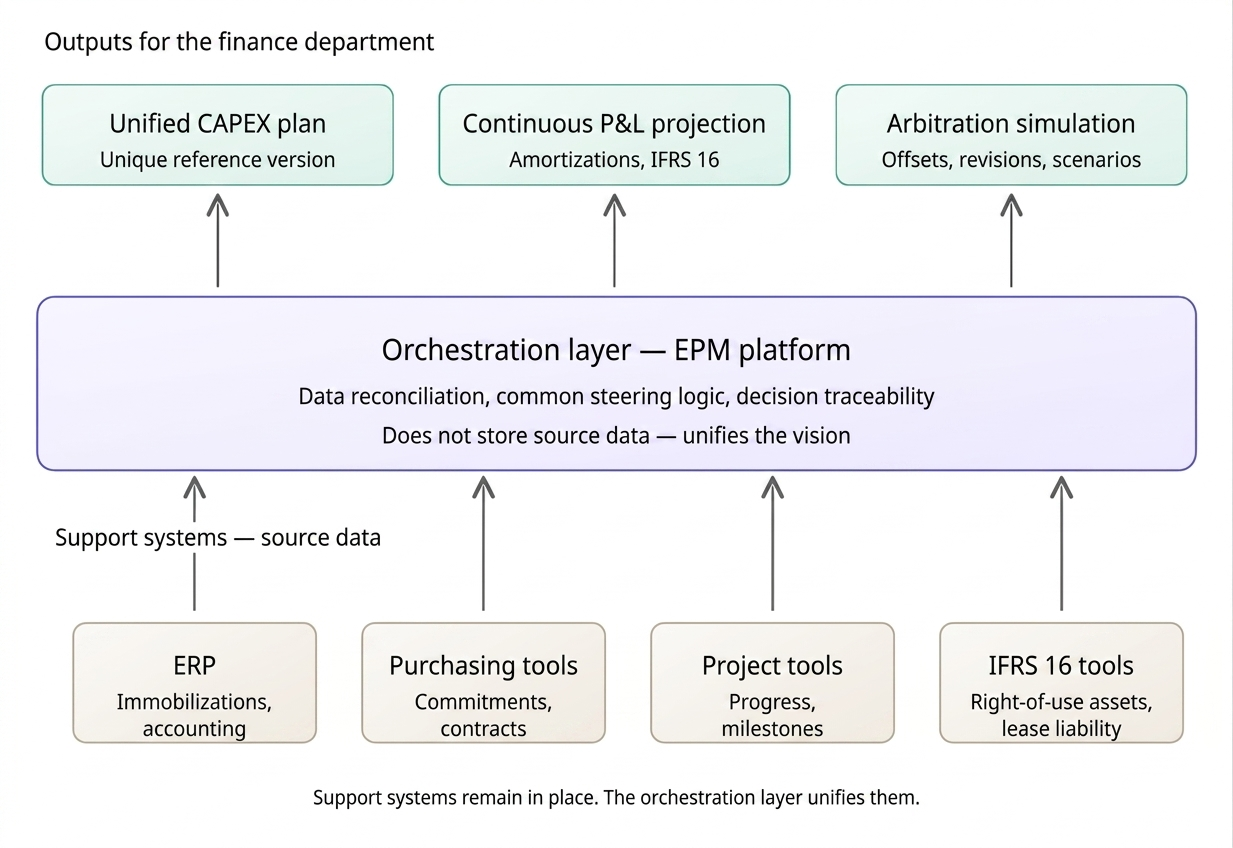
This two-layer architecture has several important implications for a finance department.
The first implication is that source data are not duplicated. The ERP remains the master system for accounting fixed assets, while IFRS 16 tools remain the master systems for right-of-use assets. The EPM platform consumes these data, enriches them with management dimensions (portfolio breakdowns, entities, scenarios), and presents them within a unified framework. No battle between repositories, no duplication, no risk of inconsistency between what is accounted for and what is managed.
The second implication is modeling flexibility. Adding a new analysis dimension, testing an alternative depreciation rule, building a scenario with different assumptions: these are operations that take hours or days on an EPM platform, whereas they would take weeks or months in an ERP module. This speed is not a convenience: it is the condition for governance to remain useful in an economic environment that changes constantly.
The third implication is simulation capability. When the executive committee asks, “What happens if we postpone the commissioning of this project portfolio by six months?”, an EPM platform can provide a quantified answer within the afternoon, including P&L impact, cash impact, and impact on financial ratios. An ERP cannot do this… and the good news is that it was never designed to.
The Three Concrete Benefits for the Finance Department
The value of an EPM orchestration layer for CAPEX management materializes through three benefits consistently identified by the finance departments we support.
A Single Source of Truth
In a well-designed EPM framework, the CAPEX plan exists in a single version, continuously updated. Data coming from different source systems are reconciled according to explicit rules, with full traceability of variances. Gone are the meetings where three teams arrive with three different versions of the same number. The question is no longer “Which version is correct?”; it becomes “How do we explain the variance highlighted by the system?”
For a CFO, this change is fundamental. It frees up analytical time previously consumed by reconciliation, restores the credibility of figures presented in steering committees, and enables — often for the first time in many organizations — a truly strategic conversation about investments rather than a technical debate about data quality.
Continuous P&L Projection
A properly configured EPM platform automatically projects the impact of CAPEX decisions on both the P&L and the balance sheet: future depreciation, financial charges related to lease contracts, leverage ratio evolution, EBITDA impact. This projection is available at any time, not only during closing.
Concretely, this means that a commissioning delay, a revision of depreciation duration, or a change in assumptions related to an IFRS 16 contract immediately flows through to the forecasted landing position. The finance department moves from a logic of observation — discovering variances at closing — to a logic of anticipation: seeing them form and being able to act before they materialize.
Simulation Capability for Strategic Decisions
This is perhaps the most transformative benefit for the finance function. An EPM platform makes it possible to build, in real time or close to it, alternative scenarios along with their complete impact on the financial trajectory. What would be the effect of postponing an investment program by one year? Of renegotiating the duration of a lease portfolio? Of accelerating the commissioning of a project portfolio? What would be the impact on margins, cash, and ratios communicated to the market?
These are questions finance departments regularly receive from executive management, boards of directors, or investors. Without a simulation platform, they lead to lengthy Excel exercises that are unreliable and difficult to audit. With an EPM platform, they become a normal part of the management dialogue, and the finance department gains a strategic advisory role it previously struggled to exercise.
What Matters Is the Model, Not the Tool
There is, however, one point that must be made very clearly, because it lies behind a large proportion of disappointments in finance transformation projects. The value of an EPM platform does not come from the tool itself. It comes from the model it supports.
A powerful tool applied to a poorly designed model simply reproduces existing inconsistencies faster. Organizations that purchase an EPM platform expecting it to solve their management issues quickly discover that the tool amplifies whatever is fed into it, whether good or bad. Data structuring, management rule definition, process formalization, clarification of responsibilities: these preliminary efforts are decisive and far more important than the choice of one platform over another.
This is why, in our experience, successful projects always start with the model rather than the tool. We begin with a diagnosis of the existing framework. We then formalize the target model: repositories, rules, responsibilities. The tool is deployed afterward, as the execution layer of an already designed model. It is less spectacular than a platform demonstration, but it is what makes the difference between a truly operational framework and a proof of concept that does not survive beyond its first year.
An Architectural Question, a CFO Decision
Let us return to the initial question. Should an organization implement an EPM platform if it already has an ERP? The answer is not about competition between two tools, but about understanding finance IT architecture. The ERP is a transactional and accounting layer — indispensable, but insufficient for management purposes. The EPM is an orchestration and modeling layer that does not replace the ERP but gives it its full value as a financial management tool.
The real question is therefore not “ERP or EPM?” but “How should the two be articulated together?” And this articulation is above all a finance department decision, not a technical choice to delegate to IT. Because it is the CFO who bears the consequences of a poorly designed architecture: unexplained forecast variances, degraded management dialogue, inability to simulate scenarios, and weakened financial communication.
In our view, over the coming years, the ability to manage CAPEX through an EPM framework properly integrated with the ERP will become a standard of the modern finance function. Organizations that fail to undertake this initiative will fall behind — not only technically, but in the very quality of the strategic dialogue they are able to maintain with executive management and governance bodies.
This initiative is not trivial, but neither is it out of reach. It requires a clear vision, direct CFO sponsorship, and a disciplined sequence: diagnosis, modeling, iterative deployment, and change management. It is at this cost that an EPM platform fulfills its promise and becomes what it is meant to be: not another tool added to an already crowded ecosystem, but the layer that finally gives the CFO control over the organization’s financial trajectory.