
IFRS 16 and CAPEX: the Desynchronization CFOs Underestimate
IFRS 16 has shifted the boundary of CAPEX. Why do lease contract modifications escape financial control, and how can coherence between operational decisions and P&L impact be restored? Analysis.

By Mehdi Ben Salah, co-founder of Beyond Plans — April 24, 2026

IFRS 16 has shifted the boundary of CAPEX without resolving the issue of governance. Between decisions made on the operational side and impacts discovered at closing, financial consistency deteriorates. EPM platforms now make it possible to bridge this gap by continuously connecting commitments, their accounting treatment, and their effects on the P&L.
A lease renewal signed in June, discovered by accounting during the half-year closing. An amendment to a telecom tower site contract that changes the usage term without anyone on the finance side anticipating its effect on lease liabilities. A P&L impact revealed urgently, two days before an audit committee meeting. Financial departments that have been applying IFRS 16 for several years are all familiar with these situations. They rarely talk about them.
Seven years after the standard came into force, the accounting debate is over. Teams know how to calculate a lease liability, discount cash flows, and process contract modifications. Dedicated tools exist and function properly. And yet, the gap between what IFRS 16 should enable — namely, an integrated view of lease commitments within the financial trajectory — and what actually happens in most organizations remains significant.
The issue is no longer accounting-related: it is organizational, and it reveals a broader weakness in the way finance departments currently manage their CAPEX.
IFRS 16 Redefined the Boundary of CAPEX
Before 2019, the distinction was clear for most practitioners. On one side, CAPEX: physical investments, supported by business cases, depreciated over their useful life, and managed through dedicated processes. On the other, operating leases: recurring expenses, handled on an ongoing basis, with no balance sheet impact.
IFRS 16 erased this boundary. The standard imposed the capitalization of nearly all lease contracts on the lessee side, with the recognition of a right-of-use asset on the balance sheet and a lease liability on the liabilities side. Commitments long treated as simple rent expenses (real estate leases, telecom tower sites, vehicle fleets, etc.) became full-fledged assets, with their own depreciation logic, their own financial charges, and their own lifecycle events.
For the many affected sectors (telecoms, retail, logistics, energy, services, etc.), this extension represented a substantial expansion of the CAPEX perimeter. Depending on the organization, right-of-use assets may now represent 20%, 30%, or more of gross fixed assets. This is no longer a marginal category. It is a structuring component of both the balance sheet and the P&L.
Yet in many organizations, governance frameworks have not kept pace with this shift. Dedicated IFRS 16 tools were implemented — it was urgent, the accounts had to be produced. But they were grafted onto existing systems, often under the sole responsibility of accounting teams, without integration into CAPEX management processes. The standard is applied; overall consistency is not.
Desynchronization in Practice
The IFRS 16 mechanism has one characteristic that governance frameworks have not always absorbed: every lifecycle event of a lease contract produces an immediate accounting impact. Signing an amendment, modifying a term, exercising a renewal option, renegotiating rent, terminating early… each of these decisions triggers a remeasurement of the lease liability, an adjustment of the right-of-use asset, and a modification of the depreciation schedule.
In theory, this mechanism should be seamless. In practice, it collides with a simple organizational reality: decisions are made by operational teams — real estate departments, fleet managers, procurement teams, technical departments — who do not always measure the accounting impact of what they sign. And the accounting departments responsible for translating these decisions into entries are not systematically informed in real time.
The result is a recurring pattern that we observe in the engagements we conduct. An operational decision made in May. A contract signed in June. A transmission to accounting (sometimes by email, sometimes through an Excel file) in September or October. An IFRS 16 recalculation carried out urgently during the half-year or annual closing process. A P&L impact discovered at the end of the process, often too late to be properly explained to the audit committee and external auditors.
Multiplied across a portfolio — and in a significant group, lease contracts number in the hundreds or even thousands — this gap mechanically produces P&L forecast variances, closing surprises, and strained discussions between finance departments, operational teams, and auditors.
The Symptom of a Broader Problem
Taking a step back, IFRS 16 desynchronization is not an isolated issue. It is the most recent and most visible manifestation of a structural phenomenon: the fragmentation of CAPEX management across systems and stakeholders that do not communicate sufficiently with one another.
Whether it concerns a traditional tangible asset or an IFRS 16 right-of-use asset, the lifecycle of an investment spans several domains: an initial request formulated by business teams; validation by financial governance bodies; a contractual commitment handled by procurement or legal departments; an execution phase managed by project teams; commissioning that triggers depreciation. Alongside this come lifecycle events (modifications, amendments, revisions, etc.) that affect the asset throughout its duration.
Each of these stages generates data, in different systems: ERP platforms, procurement tools, project management tools, IFRS 16 solutions, Excel consolidation files. Each of these stages involves different stakeholders with different priorities. Consistency across all these dimensions does not emerge spontaneously. It must be organized… yet in most cases, it is not.
To illustrate the scale of the perimeter that must be managed, here are the seven major categories of assets and commitments that make up the modern CAPEX lifecycle. Many organizations still actively manage only the first two or three categories.
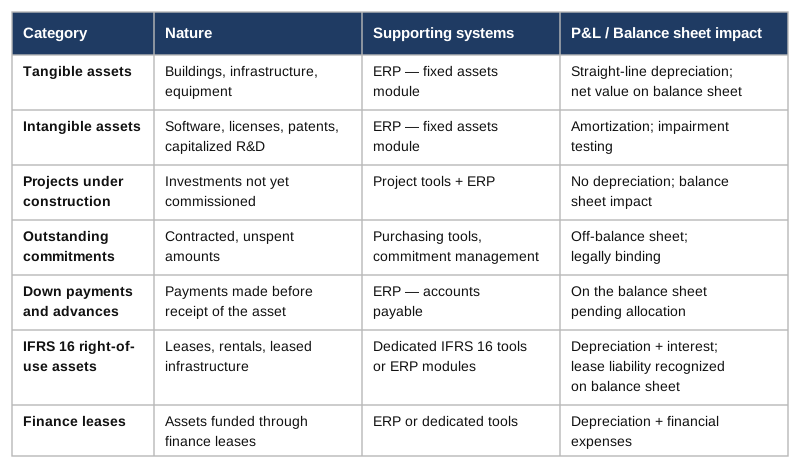
This mapping highlights two important realities. First, the dispersion of supporting systems: the same organization manages these seven categories across five or six different tools, which are rarely interconnected.
Second, the asymmetry in maturity: most frameworks adequately cover traditional tangible fixed assets, but handle other categories (unexecuted commitments, IFRS 16 right-of-use assets, finance leases) in a far less structured way. Yet all of these categories contribute to both the P&L and the balance sheet.
Consequences Beyond Margins
For a finance department, IFRS 16 desynchronization — and more broadly, CAPEX fragmentation — has consequences that go far beyond the immediate impact on margins.
On Forecast Accuracy
Right-of-use assets and their lifecycle events are now one of the main sources of variance between in-year P&L forecasts and closing reality. Finance departments that fail to capture lease contract modifications in real time find themselves explaining, quarter after quarter, variances they could have anticipated. Over time, this erodes the credibility of management discussions with the executive committee and the board.
On Cash and Funding Requirements
IFRS 16 has an accounting impact on the P&L, but the cash flows associated with lease contracts remain very real outflows. An organization that does not closely manage its rent payment schedules, indexation clause revisions, renewals, and terminations deprives itself of part of its cash forecasting capability. In a context of high capital costs, this capability has become strategic.
On Financial Ratios
The quality of right-of-use asset management directly influences several ratios closely monitored by analysts, rating agencies, and banks: leverage ratios (lease liabilities inflate gross debt), interest coverage, and capital intensity. A significant variance in the IFRS 16 perimeter can shift a ratio beyond a threshold — with consequences that go far beyond the quarter’s margin performance.
On Financial Communication
For listed groups, bond issuers, and organizations under private equity ownership, CAPEX guidance is scrutinized at every reporting cycle. Yet IFRS 16 commitments are now an integral part of communicated CAPEX. Weak governance turns each reporting exercise into a defensive explanation of variances rather than a lever for external credibility.
Restoring Consistency: A Matter of Architecture
The answer to these difficulties is not accounting-related… in fact, it never was. IFRS 16 is clear, and accounting tools know how to apply it. What is missing is continuity between the operational decision and its integration into financial forecasting. That continuity is an architectural issue: process architecture, responsibility architecture, and systems architecture.
From a process perspective, the challenge is to explicitly formalize the lifecycle path of a lease contract event: who decides, who signs, who informs accounting, within what timeframe, and with what information. What appears elementary is rarely documented, and when it is, procedures are rarely followed consistently.
From a responsibility perspective, the challenge is to move away from treating IFRS 16 as merely an accounting issue. The finance department must assume the role of conductor: structuring the flow of information from operational teams, ensuring consistency between contractual decisions and P&L projections, and managing the IFRS 16 perimeter as a full-fledged component of CAPEX rather than an accounting appendix.
Finally, from a systems perspective, the challenge is to move beyond a juxtaposition of disconnected tools. This is where the essential issue lies today.
Why an EPM Platform Provides a Structural Solution
Modern EPM platforms such as Anaplan respond precisely to this architectural challenge. They do not replace existing systems: the ERP continues to manage accounting fixed assets, dedicated IFRS 16 tools continue to perform calculations, and procurement tools continue to handle commitments. What EPM platforms provide is of a different nature: an orchestration layer that brings these data sources together, reconciles them according to consistent governance rules, and produces a unified financial view.
Concretely, for a finance department structuring its IFRS 16 governance with a platform such as Anaplan, three things change.
First, the ability to continuously maintain a consolidated view of the perimeter: right-of-use asset stock, lease liabilities, depreciation schedules, and projected financial expenses. This view is updated continuously as events occur (signatures, amendments, term changes) rather than reconstructed during closing. Variances become analyzable in real time, rather than explained retrospectively.
Second, the ability to simulate the impact of a decision before it is made. A lease renegotiation project, a change in usage duration, an early disposal: these are all decisions whose P&L and balance sheet impact can be assessed within hours, with a level of precision that allows the finance department to influence the decision rather than merely endure its accounting consequences.
Finally, the ability to integrate the IFRS 16 perimeter into overall CAPEX management. The right-of-use asset ceases to be a separate object handled in isolation by accounting. It becomes an asset category managed alongside tangible fixed assets, with its own specificities but within a unified framework. This unification is the condition for the finance department to regain a coherent view of its CAPEX trajectory.
Finance departments that have structured this framework with Beyond Plans have therefore moved from a reactive posture — explaining variances during closing — to a governance posture: anticipating impacts, supporting decision-making, and improving the reliability of forecasts communicated to executive committees and markets. The initiative is not trivial: it requires rethinking information escalation processes, clarifying responsibilities, and building a coherent data model. But it is within reach for an organization willing to devote the necessary attention to it.
The Finance Department’s Choice
Ultimately, what IFRS 16 reveals is that managing long-term commitments — whether carried through physical fixed assets or right-of-use assets — can no longer remain a technical matter delegated to accounting or IT departments. It is a financial governance initiative, at the core of the modern CFO’s responsibilities.
In our view, structuring the governance of expanded CAPEX, including the IFRS 16 perimeter, is one of the three or four strategic initiatives on which a CFO should personally invest energy in the years ahead. Successful initiatives systematically have direct CFO sponsorship; those led solely by management control or IT departments struggle to move beyond the pilot project stage.
IFRS 16 is now seven years old. The accounting tools that apply it are mature. It is time for governance frameworks to catch up.
IFRS 16 desynchronization is the symptom of a broader issue: the architecture of the finance information system. To explore this topic further, continue reading our article: “CAPEX Management: Why EPM Does What ERP Cannot.”